
Overview of the President of Pakistan
The President of Pakistan serves as the head of state of the Islamic Republic of Pakistan. While largely ceremonial, the president is the nominal leader of the executive branch and the supreme commander of the Pakistan Armed Forces. This role requires adherence to the advice of the prime minister and cabinet, ensuring that the presidency complements Pakistan’s parliamentary system. Asif Ali Zardari is set to assume the presidency on March 10, 2024.
Historical Evolution of the Presidency
The position of president was established on March 23, 1956, when Pakistan transitioned into an Islamic Republic. Major General Iskander Mirza, serving as the Governor-General at the time, became the nation’s first president. A significant shift occurred in 1958 following a military coup, which abolished the office of prime minister and consolidated power under the presidency. The adoption of the 1962 Constitution further enhanced this role, transforming Pakistan into a presidential republic where the president held full executive authority.
In 1973, a new constitution reintroduced parliamentary democracy, reducing the president’s role to a largely ceremonial one. However, this balance was disrupted during the military regime of 1977. The 8th Amendment, enacted in the 1980s, created a semi-presidential system, dividing executive powers between the president and prime minister until 2007. The 18th Amendment in 2010 restored the parliamentary framework, reestablishing the presidency as a ceremonial office.
Key points regarding the President of Pakistan include:
Eligibility:
- Citizenship:
- Must be a citizen of Pakistan.
- Age:
- Should be least 45 years old.
- Qualifications:
- Must be qualified to be elected as a member of the National Assembly.
- Other Requirements:
- Should not hold any office of profit in the service of Pakistan.
Selection Process:
- Election:
- The President is elected by an electoral college, which consists of the members of the Senate, National Assembly, and the provincial assemblies.
- Term:
- The term of the President is five years.
- Indirect Election:
- The President is indirectly elected, meaning that the people do not vote for the President directly. Instead, they vote for representatives who, in turn, elect the President.
Powers:
- Executive Powers:
- Appoints the Prime Minister after the general elections.
- Can dissolve the National Assembly on the advice of the Prime Minister.
- Appoints key officials, including the Chief Justice of Pakistan, the Chief of Army Staff, and the Chairman and members of the Election Commission.
- Legislative Powers:
- Can address joint sessions of Parliament.
- Has the authority to withhold assent to bills and send them back to the Parliament.
- Diplomatic Powers:
- Represents Pakistan in international affairs.
- Signs treaties and agreements, usually with the advice of the Prime Minister.
- Emergency Powers:
- Can declare a state of emergency in the country, subject to certain conditions.
Authority:
- Constitutional Authority:
- Serves as the constitutional head of the state.
- Commander-in-Chief:
- Holds the position of Supreme Commander of the Armed Forces.
Responsibilities:
- Constitutional Safeguard:
- Ensures the enforcement of the Constitution.
- Protects the unity and integrity of the country.
- Acting on Advice:
- The President acts on the advice of the Prime Minister and the Cabinet.
- Symbolic Role:
- Represents the unity of the Republic and symbolizes the state.
- Upholding the Rule of Law:
- Upholds the rule of law and ensures that the government functions within the constitutional framework.
List of all Presidents of Pakistan
Here is a more detailed overview of each President of Pakistan:
| Iskander Mirza (1899–1969): | |
| Term: 23 March 1956 – 27 October 1958 Time in Office: 2 years, 218 days Political Party: Republican Party Details: Iskander Mirza became the first President of Pakistan. His tenure witnessed political instability, and he played a role in the imposition of martial law in 1958. |  |
| Ayub Khan (1907–1974): | |
| First Term: 27 October 1958 – 8 June 1962 Time in Office (First Term): 3 years, 224 days Second Term: 8 June 1962 – 25 March 1969 Time in Office (Second Term): 6 years, 290 days Political Party: Military, Pakistan Muslim League PML (C) Details: Ayub Khan led a military coup in 1958, becoming the country’s first military ruler. While implementing economic reforms, he faced criticism for authoritarian rule and eventually resigned in 1969 amidst public protests. | 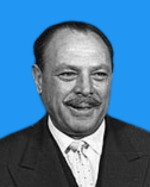 |
| Yahya Khan (1917–1980): | |
| Term: 25 March 1969 – 20 December 1971 Time in Office: 2 years, 270 days Political Party: Military Details: Yahya Khan oversaw a turbulent period, including the Indo-Pakistani War of 1971 and the creation of Bangladesh. He resigned in the aftermath of the war. |  |
| Zulfikar Ali Bhutto (1928–1979): | |
| Term: 20 December 1971 – 14 August 1973 Time in Office: 1 year, 237 days Political Party: Pakistan Peoples Party Details: Zulfikar Ali Bhutto served as both President and later became the Prime Minister. He was executed in 1979. | 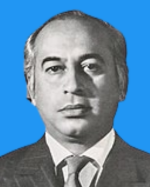 |
| Fazal Ilahi Chaudhry (1904–1982): | |
| Term: 14 August 1973 – 16 September 1978 Time in Office: 4 years, 245 days Political Party: Pakistan Peoples Party Details: Fazal Ilahi Chaudhry served as President under the 1973 Constitution. The presidency became a ceremonial role with executive powers vested in the Prime Minister. | 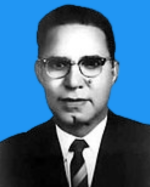 |
| Muhammad Zia-ul-Haq (1924–1988): | |
| Term: 16 September 1978 – 17 August 1988 Time in Office: 10 years, 123 days Political Party: Military Details: Muhammad Zia-ul-Haq led a military coup in 1977, implemented Islamization policies, and remained in power until his death in 1988. | 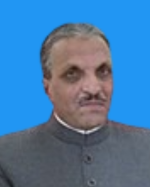 |
| Ghulam Ishaq Khan (1915–2006): | |
| Term: 17 August 1988 – 18 July 1993 Time in Office: 4 years, 325 days Political Party: Independent Details: Ghulam Ishaq Khan served as President and played a role in dismissing two elected governments. He resigned in 1993. | 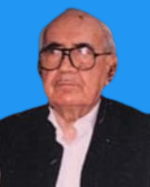 |
| Wasim Sajjad (1941–) Acting: | |
| Term: 18 July 1993 – 14 November 1993 Time in Office: 119 days Political Party: Pakistan Muslim League (N) Details: Wasim Sajjad acted as President for a brief period. | 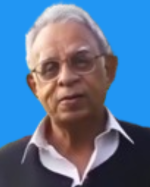 |
| Farooq Leghari (1940–2010): | |
| Term: 14 November 1993 – 2 December 1997 Time in Office: 4 years, 18 days Political Party: Pakistan Peoples Party Details: Farooq Leghari was elected President but resigned in 1997, citing differences with the government. |  |
| Wasim Sajjad (1941–) Acting: | |
| Term: 2 December 1997 – 1 January 1998 Time in Office: 27 days Political Party: Pakistan Muslim League (N) Details: Wasim Sajjad acted as President for a short duration. | 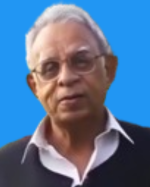 |
| Muhammad Rafiq Tarar (1929–2022): | |
| Term: 1 January 1998 – 20 June 2001 Time in Office: 3 years, 170 days Political Party: Pakistan Muslim League (N) Details: Muhammad Rafiq Tarar was elected President during Nawaz Sharif’s government. |  |
| Pervez Musharraf (1943–2023): | |
| First Term: 20 June 2001 – 15 October 2007 Time in Office (First Term): 6 years, 117 days Political Party: Military Second Term: 19 November 2007 – 18 August 2008 Time in Office (Second Term): 263 days Political Party: Pakistan Muslim League (Q) Details: Pervez Musharraf led a coup in 1999, became President in 2001, and resigned in 2008, facing criticism for his policies. |  |
| Muhammad Mian Soomro (1950–) Acting: | |
| Term: 18 August 2008 – 9 September 2008 Time in Office: 22 days Political Party: Pakistan Muslim League (Q) Details: Muhammad Mian Soomro acted as President for a brief period. | 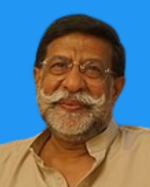 |
| Asif Ali Zardari (1955–): | |
| Term: 9 September 2008 – 9 September 2013 Time in Office: 5 years, 0 days Political Party: Pakistan People’s Party Details: Asif Ali Zardari, husband of Benazir Bhutto, became President and completed his term in 2013. |  |
| Mamnoon Hussain (1941–2021): | |
| Term: 9 September 2013 – 9 September 2018 Time in Office: 5 years, 0 days Political Party: Pakistan Muslim League (N) Details: Mamnoon Hussain served as the 12th President of Pakistan. | 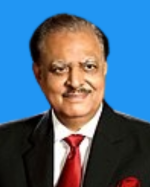 |
| Arif Alvi (1949–): | |
| Term: 9 September 2018 – Present Time in Office: 5 years, 126 days Political Party: Pakistan Tehreek-e-Insaf (PTI) Details: Arif Alvi became President in 2018 and is associated with Pakistan Tehreek-e-Insaf (PTI). |  |
Asif Ali Zardari (1955–)
Term: 10 March 2024 – Present
Time in Office: still continue
Political Party: Pakistan People’s Party (PPP)
Details: Asif Ali Zardari assumed office as the 14th president of Pakistan on 10 March 2024 after winning the 2024 presidential election. His tenure represents a return to political leadership under the Pakistan People’s Party.